SmartAxis
A zone-axis alignment software for nanocrystals and beam-sensitive materials.
SmartAxis is a software tool for rapid and accurate zone-axis alignment in transmission electron microscopy. It is designed for nanocrystals and electron beam-sensitive crystalline materials, where conventional alignment is often time-consuming and dose-intensive. By linking beam tilt with stage tilt, SmartAxis helps users reach target zone axes more efficiently while reducing repeated adjustment and unnecessary electron exposure.
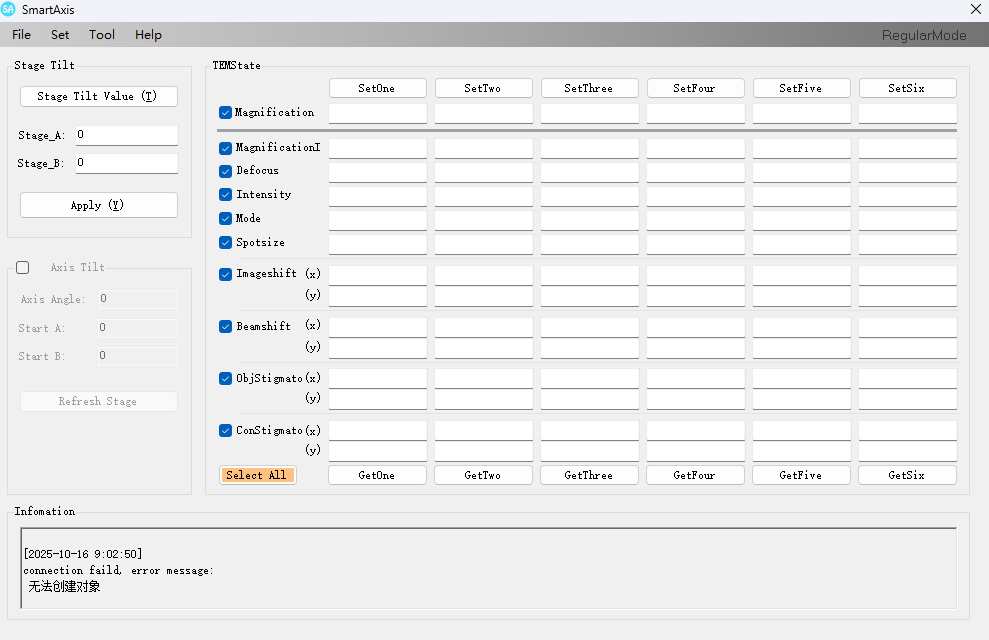
Why SmartAxis
Precise zone-axis alignment is essential for techniques such as SAED and HRTEM, but it becomes especially difficult for very small crystals because stage tilting can cause large specimen drift and repeated switching between imaging and diffraction modes. SmartAxis addresses this problem by using incident beam tilt to estimate the angular deviation from the target zone axis and converting that deviation into the corresponding stage α and β tilts for correction.
Representative Results
In the reported study, SmartAxis enabled high-resolution imaging of the same small Au nanocrystal along multiple zone axes and was also successfully applied to electron beam-sensitive MIL-101 MOF crystals. These results demonstrate that the software can improve alignment efficiency while saving both time and electron dose in practical TEM experiments.
Demo video
The demo video below shows the basic SmartAxis workflow for TEM zone-axis alignment, including beam-tilt-assisted adjustment, stage correction, and routine operation during alignment. It provides a practical overview of how SmartAxis supports faster and more reliable alignment in real experiments.
Deployment and Installation
The operating environment of SmartAxis requires .NET Framework 4.0 and ScriptHost 5.7. The official download links are as follows.
Microsoft .NET Framework 4 (Standalone Installer)Windows Script 5.7 for Windows XP
Citation
If SmartAxis contributes to your research, please cite the following publication in your resulting papers or acknowledge the software appropriately:
Zhou, J.; Wang, Y.; Lu, B.; Lyu, J.; Wei, N.; Huang, J.; Liu, L.; Li, X.; Li, X.; Zhang, D. SmartAxis, a software for accurate and rapid zone axis alignment of nanocrystalline materials. Nano Materials Science 7 (2025) 297–303.